Monday, 14 December 2015

Evaluation

W6

Evaluation of the Devising Process + Performance

Rehearsal
In terms of Rehearsal, not everyone showed up every rehearsal we scheduled and this was very frustrating at times. However, the majority did and this helped us progress as a group and become more familiar with what we were doing, especially in the early weeks of the devising process. If I had to do this again, I'd say that the amount of rehearsals we had was sufficient because we were productive in class and out of class, so didn't need lots and lots more of rehearsals compared to the ones we did have.  My only query is for those who didn't turn up to rehearsals because it meant that we wasted time recapping the new changes and adaptions to the piece to those people. Other challenges of rehearsals were the fact that our performance heavily relies on having an audience because the audience lead the action, it is built around them and where they are within the piece. Also, using props such as the washing line (which we didn't have sorted until a week before) were essential and without this prop and an audience, we were unaware of how much space we needed to leave for fifteen people. Finally, another challenge of rehearsal time was that because we were based in the Space, a very popular room for rehearsals within the school, when we weren't rehearsing there, we'd usually be rehearsing in a smaller space. In this smaller space, we'd have to compress the amount of props and space we were using to fit and then when rehearsing in the Space, we'd have to make it bigger again to utilise all of the room.


Set, Music, Lighting + Props
The set was one of the most effective parts of our piece and it was very convenient for us to use The Space, such a wide and equipped room. I really enjoyed setting it up with other people in my group and it ended up that everyone came together to incorporate their own ideas on what the set should look like.  Also, many audience members complimented the set and its creativity. 


This is the entrance door with Indian tourist destinations stuck on. This was my idea and I think it was effective because it gave the audience an idea of what country they were in and a thinking point before they entered the room. It could have easily become very unclear without little hints like this for the audience to understand where the piece was set and the location was absolutely vital for them to know.


The set from the entrance door.  The audience don't see this entire space at first. From this picture, we can see that the room is a lot darker as the audience enter and a lot lighter as they reach the other end of the room. Plastic bags were used, kindly donated by post 16, to represent the litter and over population in India. This idea was very good because it filled the space and made the set stand out so much more but the only problem was that some of the plastic bags were hazards for audience members walking by. We fixed this by moving plastic bags and making slight pathways out of them.


The area the audience were  trapped in via the washing line. The washing line was effective because we always knew where our audience were at all times and it helped them use their senses to build a more immersive experience.


The audience were released out of the tiny space and were moved to Aaron's stall. Behind Aaron's stall, they may have seen the drawings on the wall, handrawn by us and our younger family members.  This is a multimedia element, portraying ideas through art.


Aaron's stall. It had the Indian flag on it, with oranges, water, apples, pears and spice. The Indian flag was again another hint to the audience and props from Aaron's stall were used in latter scenes in the piece.


The view of Aaron's set.


The next place the audience were taken to was the 'Homeless hut', where Zafra and Amelia were. We decorated the outside of the white block with newspaper. I think this idea was purely based on knowledge of finding out during research that many street children sleep in cramped, unhygienic places such as under railway bridges.


Inside the homeless hut were old sheets, newspapers and pictures of Western idols and Bollywood idols. There was also pictures of their family members that we have stuck there. Pictures of these people inside gave the characters in the hut more dimension because it shows they're human, rather than just being 'miserable homeless people'. The problem with the hut was that the audience had to squat to see the ongoing scene and those who didn't do this had difficulties seeing what was happening. This could have destructed their illusion and broken the immersive theatre as they struggled to see the action and may have gotten distracted.


The next part the audience are taken to is a studio in India.  We made this by simply using one white block, Amelia sat on the stool and Esme took pictures of her, making her do uncomfortable poses. The camera was made by Mr Rennison out of Nesquick tubes and velcro, useful for our next scene.


The next part was the Physical Theatre part of the piece, the final 'scene'. We used a shelf, which Ruby and Charlie did their gesture theatre on and myself and Poppy used rags/sheets underneath the action on the shelf, to create a scene about kids taking drugs. We used the camera from the previous scene which contained peanut butter, to act as the 'drugs'. This is one of my favourite elements of the piece we create because it shows in an abstract way that when the kids have the camera in their hands, then rip it apart and it becomes the drugs they sniff,  the way in which many street children's motives are to steal valuable equipment like cameras (as Amelia did) and use it for drugs because so many young children are addicted in India.


Lighting
The lighting in this piece was good. It brought our set to life by conveying certain emotions through colours, for example 'dark blue' could convey misery, shame etc and showed the time scale of Day-Night from lighter areas of the room to other ones.


Props + Music used
Throughout the course of the piece, we used a strap over the shoulder bag that I brought in, that was colourful and tie-died (fitting in the theme of India/Indian fashion). I put this bag over my shoulder and used Amelia's iPad mini to play the music we used in this piece. (See Performance Material post). This was my idea and although this was a creative way of controlling the music and making the music always be around the audience, sometimes it was difficult to be involved in the action and move the washing line while controlling the music. Also, I don't know if the music we played was heard by every audience member.  However, because we didn't have speakers and all of us were participating in things, this idea really worked and I think it was done in a way which didn't direct the audience's attention.


In terms of music, I was very passionate about having a continuous drum beat over certain pieces  of the piece created by us as actors, such as the gesture theatre piece at the end. However, the idea and mood of it was a soft, relaxing atmosphere and the idea of a drum beat was a bit too harsh.


In general, the props were absolutely essential otherwise this immersive piece would not have worked out. They help provide realism for the audience and take them into another world by blocking out their reality, they help engage the audience and they help contain the audience (e.g washing line)

The Performance
One of the challenges of this performance was the timing.  A number of times, when we'd just let one audience out, we'd notice that another audience would already be stood there ready. This may have broken the immersive theatre experience for them and setting up quickly enough to be there ready to let a new audience in was a challenge, however I think we overcame this well. We remained calm and just returned to our positions in neutral stance ready, with all the props we needed. Times when the audience were left waiting outside never exceeded around 2-3 minutes.


Another challenge was the fact that sometimes audience members surprised you. There'd be young audience members or the audience would make something very serious rather comical, which wasn't the mood we were trying to portray. Although different audience members will interpret things differently, sometimes the mood was lost generally in moments like this.  We had to improvise around this because the audience entirely lead the piece, not us or else it wouldn't be very naturalistic.

Something that I believe really worked within our piece was Aaron's interaction at the stall.  I think it's because it really made audience members get involved. Aaron played his character so convincingly and really committed, forcing audience members to say something and feel more included in the action.  It also showed very clearly con artistry in India, which is something very interesting that some of the audience members may have never learnt before.

At the end of our performance, all groups/'camps' joined up together to sing a song. It incorporated the theme of the entire piece: the older generation have left the world in the state that it is in, with unethical things happening all over the World and what can they do to help? As well as this, we ended the performance on some personal audience interaction: we would take an audience member and improvise by questioning them. 'What did you want for the world when you were younger?' 'What do you want for your children?' etc and ending on 'You can have what you want. You are powerful'.  Because it was an intimidate questioning, it really helped us connect to the audience. It was the last thing they were given during the performance and it holds so much meaning and inspiration so it leads a lasting mark on the audience and makes an impact, the aim of our piece.

Other groups had some really effective ideas that contributed to the successful play too. I particularly liked the idea of Guantanamo Bay's group, having Barack Obama's speech play. It incorporates multimedia aspects and shows how some things are portrayed in the media compared to what they actually are.

Things I've learnt during this unit
This is the first time I'd ever done immersive theatre and especially after this unit, I believe it is very important. This is because you can make the audience whoever you want and make them believe and think and open their mind to different situations that some of them would never consider on a daily basis until they were being forced by to do a stress position by Brit School students. A lot of the audience members went away with something to think about, no matter what it was that they took from the play and this is an important element to theatre.

Secondly, I learnt just how research is absolutely essential to everything in theatre, especially devising. You want to use real stories to make your characters real and non stereotypical and to give your audience a truly realistic impression.  I definitely developed the skill of shaping research into presented theatrical ideas in the piece. For example, the statistics of runaway adolescents from their parents was represented through our gesture theatre piece at the end with a girl and her dad. (Ruby and Charlie) This links to last terms unit, about knowing your character.

I also developed the skill of devising in teams. With a lot of passion brings a lot of voices and you have to be open to other people's ideas, as well as being able to have ideas rejected or ideas adapted for the sake of the performance.

Finally, I learnt during this devising unit that the audience lead everything. The skill of having to adapt and improvise dependent on the audience is very important to have because if you don't, it'll break the illusion for them completely.

Sunday, 6 December 2015

Week Five

W5

During Week Five, we rehearsed using most props that we brought in and performed to a small group of people. This helped us gain an insight into what was working in our piece and what wasn't. From this exercise, we realised that our piece wasn't effective enough. There was a lot of lulls and it seemed very stereotyped and boring. Mr Rennison helped us direct and adapt the piece and with that, we endured a lot of new ideas and thoughts about how we wanted the piece to be. 

Updated Timeline of Performance

Time limit: 10 minutes
Time scale: morning-night

1-3 mins:
  • Audience enter through door. Escorted by Mia and Rio. Airline sounds, symbolising tourism. 
  •  Immediately captured in washing line by Poppy, Lili and Charlie. Cramped space: representing crowded street bustle of India.  They will be captured in the washing line most of the time, maybe a metaphor of the blockade between the unexposed scenes of India and the generalised stereotypical view of India seen by tourists.
  • Immediate traffic sounds (see Performance Material post)
  • Washing line holders: general information on India homelessness, facts & figures (30 seconds): See Performance Material.
  • Washing line straightened out to other side of the room, blocking off the audience from rest of the room. 
  • Aaron stall owner improv: interaction with audience - throwing of oranges, stealing of oranges, stealing accusation. Tension will build up and up until escorts are forced to exit: washing line moves to next scene. 
3-5 mins:
  • Washing line holders move to middle of room: information on street children's day in a  life statistics and facts, with locations and activities (30 seconds)
  • Block shelter: lifted up 
  • Zafra (stealer of oranges) finds refuge and crawls in the block, this gives the audience a reason to be let in on the action.
  • Lifting of block: exposes rubbish, pictures of Indian idols & family plastered on
  • 4th wall not broken, displaying innocence and purity of street children as they open oranges and talk to each other: improvisation.
5-7 mins:
  • Washing line holders move to next scene: facts and figures on Exploitation. (30 seconds)
  • Exploitation scene
7-9 mins:

  • Drug and substance abuse facts and figures
  • Gesture theatre piece between father and daughter (Charlie and Ruby)
  • Street children 'drugged out' going to sleep
  • Audience interaction: Looking for daughter
9-10 minutes:
  • Airline voiceovers
  • Audience exit
  • Actors reset the stage area for next group

Scene 1: 
In Scene 1, we have a multimedia approach to begin the piece, where the audience hear voiceovers as they enter of airline sounds. This shows how they have landed in another country. They will also almost immediately hear the lulling sound of traffic, which will be played throughout the whole piece.  The capturing of a squashed audience in the washing line represents the hustle and bustle of a real life Indian street and these two features demonstrate elements of Realism, where the audience have to use their senses to capture the feeling of being squashed and cramped into a small space, something that almost immediately creates the impression that they've arrived into a different world.  Street children like Amelia could reach their hands in and interact with the audience. In each scene, the washing line holders (myself, Poppy and Charlie) are going to say some facts and figures about homelessness in India. The facts and figures here will be General Information.  The audience will be directed by Mia and Rio as tour guides throughout the piece. 

Scene 2:
In this scene, this is where the audience get involved into the piece, to make them feel like they're part of it and to give them a purpose. Aaron is using the idea of throwing oranges to each audience member and then accusing them of stealing it and making them pay. This will potentially force any audience member to interact back with him and it makes the performance much less boring and more immersive. The audience are still restricted from the rest of the room by the washing line, which will be a key prop throughout the entirety of the piece. The tension in this scene between Aaron and the audience will build up and up until Mia and Rio are forced to exit this area of the room, giving the audience more flow and direction. 

Scene 3: 
As we transport the audience to the middle of the room via the washing line, the washing line holders will read facts and figures based on the day in the life of street children, where you can find them etc. The audience will then be introduced to the home of 3 street children, underneath the white block, which could represent a small and desolate alleyway or the underneath of a bridge. The 4th wall will not be broken in this scene so the audience can get a clear image of a conversation between three street children, perhaps talking about stealing oranges. 

Scene 4:
Facts and figures about child exploitation in India will be read out by the washing line holders as the audience are moved to the next part of the piece: a studio. Amelia (a streetchild) and Esme will expose the harsh reality of child exploitation in a short scene which will branch directly into the next scene. 

Scene 5: 
Facts and figures about substance abuse will be read out by the washing line holders. The idea that drugs are a significant role in the day to day lives of young street children is a shocking yet prominent aspect of homelessness in India and we are going to portray this idea. Street children that are zoned out on the use of drugs will be sleeping in dangerous outside environments, using basic materials (that we have brought in) such as cardboard, dirty sheets and plastic bags. The lighting of the room is much darker on stage right to show that it is night and the traffic sounds will still be continually playing, to show the realism aspect where audiences hear the jarring, non stopping sounds that street children hear all day. Charlie, taking on the role of a father, will then begin to interact with the audience, saying that he has lost his daughter and telling the story of the crumbling of their relationship. Again, this adds to the idea that the audience are included and makes it more immersive. To end the piece, a gesture theatre/physical theatre piece will occur between Charlie and Ruby as father and daughter are reunited and it tells the story through movement. The piece will then end with the queue of airline sounds, to symbolise the end of the tourist holiday.

Wednesday, 2 December 2015

Performance Material

Material for Performance


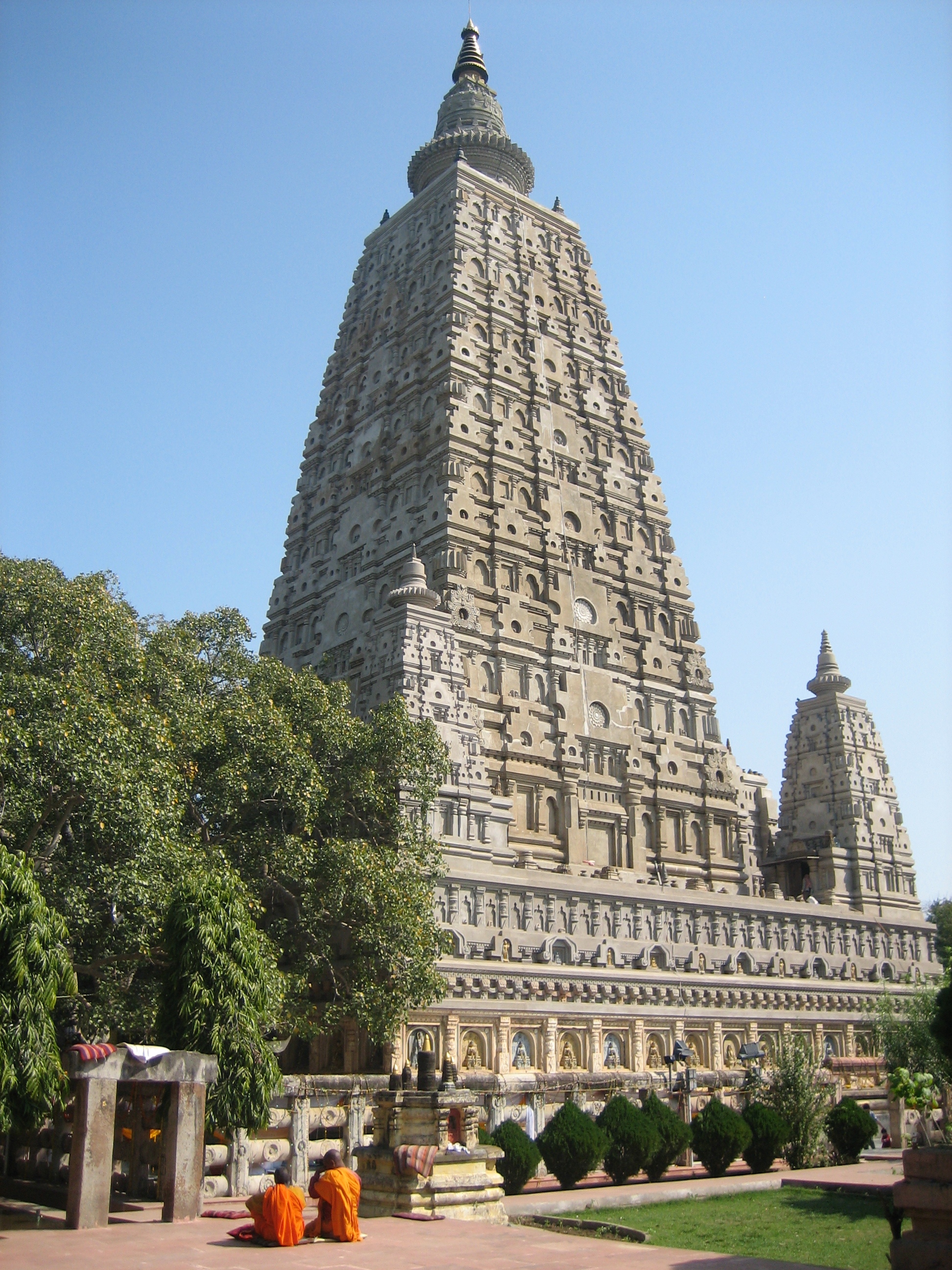
Above are pictures of Indian tourist destinations, such as the Taj Mahal. We aim to have these on the   outside door of the Space because they show how India is portrayed in the media, with it's majestic, tall and prestigious buildings compared to the inside of the door, where it represents India in poverty and the hidden scenes from tourists.  This can present a theme of Social Injustice in our piece. In many areas of India, there will be really run down slums with dying, sick people directly next to an area of wealth and prosperity. This aspect suggests that social division. 


Traffic Sounds: these are the traffic sounds that will be played throughout the piece. 


Bollywood idols & family photos (to go in the street child's base):


Sunday, 29 November 2015

Week Four: Ideas


W4

Final Timeline of Performance


Time Limit: 10 Minutes


1-2 mins:

  • Audience entrance, escorted by homeless escorts. Airline sounds will sound as audience enter, symbolising tourism.
  • Audience see Indian destination pictures on door: thinking point (more detail below)
  • Traffic sounds: Indian Street Traffic Sounds, jarring, constant sound
  • Aaron's food stall: audience interaction/improvisation, pickpocketing, stealing oranges etc
  • Informative wall: everyone in the group incorporated their own ideas on what could be on the wall: missing posters, wanted posters, drawings drawn by young children, quotes, art, poetry etc. 
  • Capture by washing line. Using sensory aspects as they feel ragged clothes on washing line. Ruby, Lili & Charlie holding washing line.


3-4 mins:

  • Orange Community
  • Gesture Theatre: homeless day.
5-7 mins:

  • Opening the box (Amelia's story)
  • Child trafficking

8-10 mins:

  • Wall Gesture Theatre by Ruby and Charlie (a story)
  • Audience exit, escorted by homeless escorts

Ideas I generated for the piece:

Costume
  • An idea I generated for the piece was that every actor should wear black. This creates a common chain of familiarity and community. The colour black could also represent simplicity: the fact that the street children don't have a lot. However, it can be seen as rather stereotypical and two dimensional so if each person had a particular accessory, such as a small necklace, bracelet, hat or headband, it gives them some meaning and character, rather than just being a 'bland streetchild with no story'. However, our group eventually decided that this isn't realistic enough for an audience. However, possibly, this could maybe be more suitable for the washing line holders, who can blend into surroundings more easily. 
Lighting
  • Another idea I generated was that the room should be completely dark and lifeless. The audience have to find their own way round, with torches and they can bump into anything. I liked this idea because it portrayed an idea of uncertainty and danger because you don't know what is coming next - much more realistic to just having the whole room lit up. However, this idea was later rejected because it didn't seem feasible to have every audience member have a torch.  It also didn't portray the time scale of morning - night clearly.

Stylistic elements 


  • In our Monday lesson with Miss Lee, I generated the idea of having a soundscape when the audience arrive and are trapped into the washing line. This area of the piece seemed to be rather bland and dry and having a soundscape would help fill this time with intriguing material. It's using sound to help set the scene of a street. Deep, harsh sounds could represent the traffic on the road and can collide with sweeter, softer sounds that could represent innocent street children in an unethical situation. Our team decided to go with this for this reason.
  •  I came up with the idea to have a gesture theatre piece that depicts the daily life of a streetchild in India, from playing, to begging, to hiding, to stealing. We went with it because we wanted to show the story with movement because it would be more interesting and movement is arguably more powerful than just words or a thought track. Secondly  at this point in the play we'd have the audience under our grasp. To get the audience involved, I also thought it would be very interesting to at the point in the play where we plank, have every audience member crawl underneath us to symbolise a bridge: somewhere where a street child may find refuge for the night. However, we later deducted this idea because we thought it was too ambitious and would take too long for every audience member to crawl underneath only three of us in a limited time.  As well as this, with only three of us, the idea of it being a 'bridge' may not have been as clear. 

Set
  • It would be effective to have plastic bags spread out all over the floor of the piece, representing the litter in India. Many street children work at dumps all day sifting through rubbish piles looking for things valuable and it's a huge cause of disease and death in India for many. Having this detail in our performance could hugely show that and we could have that idea also displayed in artwork on the wall too.
  • On the door will be pictures of Indian destinations. This was an idea I generated and we chose to stick to because it shows the 'stereotypical' image of India on the door but as soon as the audience enter, they can see some of the deeper, less exposed scenes that are hidden away from tourists. It's a thinking point for the audience. 

Extra details
  • I also thought it would be really effective to give audience post it note roles as they walk in. We are giving them the role of tourists but by giving them post it notes with 'John Smith. 36. Originates from Kenya. Visiting from London' it just gives the audience some purpose and a reason to be there, rather than just being a parent. We can also respond to where they are. For example, in India, Mr Rennison told us that they link Manchester United with the UK and we can incorporate ideas of this into our piece with various different people and backgrounds. However, our team is still deciding on this and how feasible it'd be. This idea could possibly link to Camp America. As their audience walk in, they label them with post it notes and if our group does it, maybe it shows a common link between society all over the world 'labelling' people.
  • As well as reading out facts and figures (See Week Five - we made new changes to our piece) I had the idea that myself and Poppy, the washing line holders, should also say words at the end of our 'fact passages'. The script for it is here. Having words that we can build on every section adds some emotion and grit into the performance and we thought that this uses words as an abstract form of getting across our information to the audience. 

Evaluation:

As a team, I think we're working well overall. Every lesson, we share loads of ideas and share our opinions on them. However, especially because the final deadline is drawing to a close, we're focusing too much on producing more ideas than perfecting the piece.  As a team, we must try and work hard to bring props in, focus and perfect our piece. We can do this by setting up voice overs with Mr Hughes on our next Thursday lessons and working on our soundscape, gesture theatre pieces and audience exit scene.


Sunday, 22 November 2015

Week Three


W3:

Timeline of Promenade Performance


This week, we have been focusing on the timeline of our performance and we have been finalising our ideas. Above is a picture of the timeline of events that will last over the time scale of 10 minutes.

In our piece, the audience are tourists who have been dragged onto our Indian street by beggars, urged to come here because of the many 'stalls' and delicacies we 'have' on the street. In reality, the street is really just a place where loads of pickpockets and street children live and this Naturalistic idea we are going for really shows how the environment that the street children live in shapes them as people. 

Scene A: Entrance
Once the audience have entered through Door 5, they will see a stall where Aaron will be standing, selling oranges (a key symbol throughout our piece) We will also have written stories, artwork, poetry, missing posters etc on the wall too, which are spectacles for the audience to choose to look at as they are invited into our Indian world. On the floor, they may be walking over a cluttered mess of plastic bags or empty water bottles and a hustle of us actors might push through them muttering 'Excuse me'. They will walk into this Space hearing the sound of Indian bhangra music and the vehicle traffic sounds. All of these things are used to help transform the audience's reality from living in the UK to walking through busy Indian streets. This is part of the immersive theatrical experience.

Scene B: Washing Line
We are going to be creating a washing line using string and old clothes. With 4 of us holding the washing line, we are going to attempt to capture the audience from their positions in the washing line.  This is likewise how on a real Indian street, many street children might crowd a group of tourists and  talk to them in an attempt to earn money or even just compassion/attention. This is where audience interaction will occur and actors will talk to the audience like strangers, adding to the immersive theatre experience because it includes them in the action. It also gets them to use their senses such as touching because they're feeling the clothes on the washing line which helps create this Indian world.  I personally think this is where we can incorporate the stylistic element of Physical Theatre because the actors who are holding the washing line could do a synchronised, emphasised movement which expresses the heartbreak and tragedy of being homeless. Physical Theatre is a really interesting stylistic element because it can express so much feeling with just movement and no words and it shows the relationships between characters with just body language. It's a really powerful element.

Scene C: Orange Community
The washing line will lead the audience to a representation of an Indian community. A group of us will be sat in a circle sharing out oranges. Oranges are a key symbol in our piece because they represent superiority. It might seem so simple to people living in the Western world however to our street children, having an orange is a real treasure. This interpretation of oranges and what they mean to street children in our piece will be explored more in different elements throughout the piece and we hope that the audience can build their own interpretation on the oranges. Gaining attention of the audience, different street children might react in different ways.  Some may hide, some may whisper to other children, some may protect their oranges, some may talk to them, some of the street children might even attempt to sell their oranges to the audience because they see them as an opportunity for money.  This is an example of Brechtian: breaking the fourth wall between the audience and the actors. However,  it might also be effective to keep the fourth wall between the audience and the action closed to show the innocence and purity of the street children as they enjoy and savour the oranges. 

Scene D: Gesture Theatre
Inspired by a clip Mr Rennison showed us, (On Stage, BBC iPlayer), we hope that at this point in the piece we will have our own version of Gesture Theatre, a medium used in the clip. This was used to present the ups and downs of someone's life. I really enjoyed this clip and found it so fascinating and touching. It uses emphasised, almost dancy movements and speech to create a flowing story, where actions all link together.  Our version will have a series of short, emphasised gesture pieces that will be portrayed by different members of the group. They will be showing the daily activities of being a streetchild. This might include begging, busking, stealing oranges etc. During this, we can be begging to the audience, grabbing them, dancing around them etc. This helps get them more involved.

Scene E: Amelia's Story
Amelia's character is more isolated and doesn't belong to a community or group. Her story will be explored by using a box. Other characters will open up a cardboard box which will unveil stories and writing that depict her life and what has led her to this situation. Amelia will then become the subject of a brutal child trafficking kidnapping scene, led by Esme. Again, this shows factors of Naturalism. It's realistic that there will be street children isolated,

Scene F: Streetchildren
As the audience roam further towards the other end of The Space, the idea that the street is more urban and vulnerable will be displayed. The sound of traffic noises will be louder, the lighting will be darker and a group of street children will be trying to sleep, under dirty sheets, in plastic bags and behind stage blocks etc. 

Scene G:
This is the last thing the audience will see before they exit the room. In lower economically developed countries such as China or India, many babies, especially girls, get killed or abandoned all the time. A representation of a mother leaving her baby girl on the street with other homeless children is a last thinking point for the audience as they leave because it shows the harsh reality of the world. We have developed another Gesture Theatre piece to show this. It shows Ruby, a young homeless girl in the street child community and Charlie, a wealthy, well off person that falls in love with her and takes her out of her situation. They will be standing on the shelves to give them some level and authority while the rest of the street children will be looking up, observing the situation, encouraging the audience to do so as well. At the end, Ruby and Charlie will make the decision to give their baby girl away. 

Monday, 16 November 2015

Week Two


W2

During this week, we have begun to piece together our vision for what we want our devised performance to be like.

Performance Proposal

The people in my group are Zafra, Amelia, Rio, Aaron, Esme, Max, Ruby, Poppy, Charlie, Mia and Natasha and our performance space will be in The Space, which is on the ground floor of the school.


 (Picture to be updated soon)

The theme we have decided to work on is Indian Street children. Our group had a wide fascination with the idea of child trafficking, which is a very significant problem with homelessness in India and this eventually stemmed onto the idea to explore the lives of being a homeless child in India and what comes with it. I have been watching Slumdog Millionaire, which has helped deepen my understanding of this theme and I have used it as a creative stimulus for my thoughts and ideas.

We will be transforming The Space into an Indian street, using sound, lighting and objects in order to give the audience 10 minutes in which they can explore their imagination.  The Space is a very large room and this gives us many opportunities to incorporate as many ideas of Indian streetlife in. However, one difficulty could possibly be that it may be difficult to utilise all the space because it's so wide, therefore there could potentially be some empty spaces. To sort out this problem, I think our group should concentrate largely on objects and materials.

The Space's lighting facilities gives us the opportunity to use lighting to communicate a mood or theme. For example, our group will be using very dim lighting to bring our street to life and the fact that the room is dark might suggest a more sinister or negative mood. As well as this, if the room was lit up then the audience would know what was coming but with the room being dark, they are more intrigued and therefore engaged with what is going on and what is coming next.  The lighting will go slowly from bright to almost pitch black. This shows the time scale of morning-night and helps communicate to the audience that the day is going by. 

We will also be using music and sound effects in our 10 minute piece. The jarring, constant and loud background noises of vehicles and traffic will be playing from the moment the audience arrive and will continue until they've exited the room. This helps communicate the noises that homeless children (especially in India, a very polluted, populated country) hear day to day and the fact that it's playing for such a long time is used to aggravate the audience slightly, just like it would aggravate a person living in these conditions. This is effective because it helps the audience empathise with the situation. We are also going to be using voice recordings that will play in the performance from poetry about homelessness that has really engaged with us about homelessness. Instead of just having acting and objects, it's also interesting to introduce multimedia like poems to show a deeper understanding of the situation.

In this space, the audience have freedom to wander around, where they will encounter various 'scenes' that our group will create. For example, in one corner, there will be a few people who represent a 'community' of street children, who stick together through hardship. Ruby will be juggling and dancing as busking is ways in which many streetchildren, particularly in India, cope and gain attention. Busking is also how themes like child trafficking come in, where children who put themselves out there on the street are noticed and taken. She could be placed in the middle of the room, to show how she is the 'centre of attention' compared to the other homeless children. I think that representing this theme is hugely important in our piece.  Drug use in homelessness is another really important and vital theme in our performance. To make this more immersive, it could be interesting if people offered the audience drugs. The idea of Child Trafficking will be incorporated as when the audience are exiting the room, Esme will be attempting to sell children to the audience.

Objects such as plastic bags, string and cardboard will be essential in this piece as they are mediums that our audience can touch and they will be basic props in which we can set up our shelters and use creatively to show  the life of a homeless child. For example, string will be used to set up washing lines across the room that the audience will have to walk through or under to reach the other side of the room, using their sense of touching to build a more immersive experience. We will also have handwritten poetry, stories, drawings and any art we can find stuck on the wall in the Space as the audience enter. The stories and art will depict stories of homeless people in India and we will also be making rag dolls which will have stories written on them. To bring the theme of India to life, we will also be having numerous newspaper adverts and objects that link the piece to India around the room to make it more clear for the audience. I think that the more objects there are, the more immersive and interesting this piece will be. A list of the objects and equipment we are using is down below. 


  Immersive Theatre

A company I admire for their immersive plays is the National Theatre. Recently, I attended one of their plays Pomona, which was set in a small, circular room. We were sat in a circle around the stage and from the moment we entered, there was already action on the stage and things to look at. It wasn't like we were just waiting for the story to begin and the lights to switch off, from the moment we entered there were things to see and it was like we had just walked into that world already. I believe that this is an example of immersive theatre because it connected with me and reality had disconnected with me. I think our piece relates to this because as soon as the audience enter, they will also be transformed into that world of Indian street culture and their reality won't exist for a period of 10 minutes and this play really did that for me.


Equipment & Props List

Plastic bags: India is a country which has a lot of brands and factories, many of which will use or produce plastic bags. This will end up on the street and on the sidewalks, in which Indian street children will use as shelter or something to store their belongings in. We can incorporate this idea easily by bringing this prop in.
 String
Teabags (loose tea) & glue: to represent the drugs.
Adverts: to represent the numerous brands, factories and sweat shops that develop in India.
Written stories and artwork: to display on the walls.
Dirty sheets and rags
Oranges
Stage makeup (stage mud) 
Battered old clothes: to hang on the washing line.
Old sheets: perhaps we could use this as extra shelter or an extra layer for sleeping at night.
Empty water bottles: juggling.
Indian folk music
Chalk: to draw images and text on the walls or on cardboard that perhaps depict a street child's internal monologue. These are things that the audience can look at as well.
Voice recordings
Speakers

 Discussion 

In our 3 hour Thursday lesson, we also spent some time joining together as a whole group (Mr Rennison 's and Mr Hughes' group). In this time, we shared our ideas and took other people's feedback on how we could make our performance more 'immersive'. I think this activity was extremely helpful, especially for our group and it sparked more ideas for different ways to devise our play. 

The focus of the devising is to make it 'immersive' for the audience. This is when an audience is part of the action in a play, no matter how small their role may be. They may be able to freely roam the space that the performance takes part in and touch or feel things or they might be taken from different rooms to feel different parts of the experience. An example of a really effective piece of immersive theatre that I have seen is Sweeney Todd by the Tooting Arts club. It took place in a small, local pie shop. The fourth wall between the audience and the actors was broken and they danced on the tables we perched on, sat with us and it was almost as if we were in the scene with them. I was so intrigued and connected with the performance and even though I wasn't directly touching or interacting with objects in the scene, I believe this play was just as immersive because it really connected with me and gave me a sense of wonder because I felt so part of the scene. The point of this discussion was to help adapt each others ideas and offer advice to make their performance ideas more immersive.

Group 1: Guanatanamo Bay camp -

An idea I really liked from the Guanatanamo Bay group was the fact that before the audience have even arrived in their room, they will be blasting extremely loud music (a patriotic American song) and when the audience arrive, the room will be silent. This idea is really effective because not only does it incorporate ideas of patriotism and adds layers of a multimedia play, I think that the fact that the room goes silent when the audience arrives adds a really sense of wonder and suspense. It's almost scary or freaky and it immerses the audience because they begin to think and ask questions or may even think that something strange will happen/is happening because of the silence.  To make this idea even more interesting, once the room goes silent, the group could slowly introduce a voiceover of a voice recording. Mr Rennison recommends a voice recording that is found in the book Guantanamo Boy. This incorporates multi media and introduces the theme of Guantanamo Bay or camps in general as soon as the audience enter.  

Secondly, the group had begun to think of lighting and how that can impact that audience. They are going to use flashing, alternating spotlights in a dark, blacked out room put on various people getting tortured in the camp. This is in order to 'mess with the audience's minds' and 'confuse them'. Although this is a good idea, to take it to the next level and immerse the audience more, maybe they could be put the audience in spotlights and alternate them on them as well. This is more effective because instead of watching people getting 'tortured', if the audience feel the torture and the direct confusion and irritating, agonising motion of lights on them, it can make the performance a lot more effective and memorable. It can really make the audience think.

Group 2: North Korea labour camp -

This group had a vision that they were going to create a 'live action maze' in the room. In doing this, they are taking the audience around the room and as they reach certain areas, certain scenes will begin to emerge. A possible issue with this is that audience members don't really have an opportunity to feel, touch or explore the scenes that they encounter because they're being herded around and it might lose the immersive feel as they're losing freedom. However, I think this idea is still very strong because it is very creative and gives the audience an insight into North Korean camps. There is a lot of opportunity to showcase their research and interesting things that can make the audience think therefore they need to develop how exactly they are going to direct their audience around while giving them the freedom to explore.

This section of the play may not be distinctive as a North Korea labour camp if they don't show elements of it in the objects around the room or the 'scenes' that take place. For example, they could repeat famous speeches said by Kim Jong Un, the North Korean dictator as part of an act of discipline in the camp or sing the North Korean national anthem song. This is where an audience can get involved and can get treated like a prisoner too: they could be forced to sing the songs too.

Group 3: Camp America -

A really important theme this group wanted to mainly portray was the idea that although Camp America is often seen as 'happy' and the ideas of Florida gives connotations of 'Disneyworld' and 'dreams coming true', there are always cracks in the surface. Different characters that attend the camp signify different issues common in the age group (14-16 years old) such as depression, self harm, eating disorders, LGBT, racism etc. I really like this idea because I think that it's a really creative insight and it makes you really think out of the box. Audience members can really use this experience as an experience where they can challenge common stereotypes therefore I think that this group have really thought outside of the box.

Week One

W1
Research & Ideas

The unit we are doing this term is Unit 11, Devising Theatre. This helps us communicate our own thoughts and ideas on a topic to an audience through an immersive piece of theatre that we make entirely ourselves, using images, poetry and music as our stimulus for creativity.

During Week 1, we began to research our ideas for our end of term devised project. We split off into individual groups and our group was assigned the role of 'Homeless kids/youths' all around the world.

Zafra and Amelia were our two 'editors' and they set up a blog on the computers, documenting the research we found. Myself, Aaron, Natasha, Esme and Max were in charge of conducting research in the library. The rest of the group found research on the internet and sent them to Zafra and Amelia by email. All of this research helped us gather a wider understanding of what the real situation is in the world regarding homelessness.

'
Sophie is the youngest of three children. Growing up, Sophie's childhood was traumatic - her mum had mental health issues and her dad was an alcoholic. Sophie often suffered physical abuse at the hands of her parents. Her earliest memory is of being beaten black and blue by her dad when she was just three years old. Sophie was eventually placed in foster care and began to put her past behind her. Then, tragically, her foster mum died suddenly and Sophie found herself on the streets almost overnight. Sophie was homeless for the next three years - mainly living on the streets, sleeping in doorways and parks. During this time one of her friends overdosed. Another was raped and murdered. (A story of a teenager sleeping rough from Centrepoint, homeless charity website)


After two hours of research, we began to piece together a few ideas within our group. The devised piece we are doing will be a section in part of a walking exhibition, where the audience will be guided around various rooms to view different performances and 'exhibits'. How are we going to get the audience from one room to another? How are we going to present our research, thoughts, ideas and experiences in a theatrical way? What is the purpose of the audience? How can we engage them?

Themes 
Instead of just focusing on living on the streets, we wanted to focus more deeply on certain themes.

Here are some of our first, undeveloped themes we wanted to explore in our piece:

  • Child trafficking: we wanted this to be a significant theme within our piece because it's an increasingly large problem and it's something that members of an audience perhaps might not be aware of - this could inform them. A place where child trafficking is really prominent is in India.
  • Prostitution: a lot of women end up selling themselves for money or so they'll even get a place to sleep the night, especially in less economically developed countries. This is quite an interesting factor of homelessness to explore.
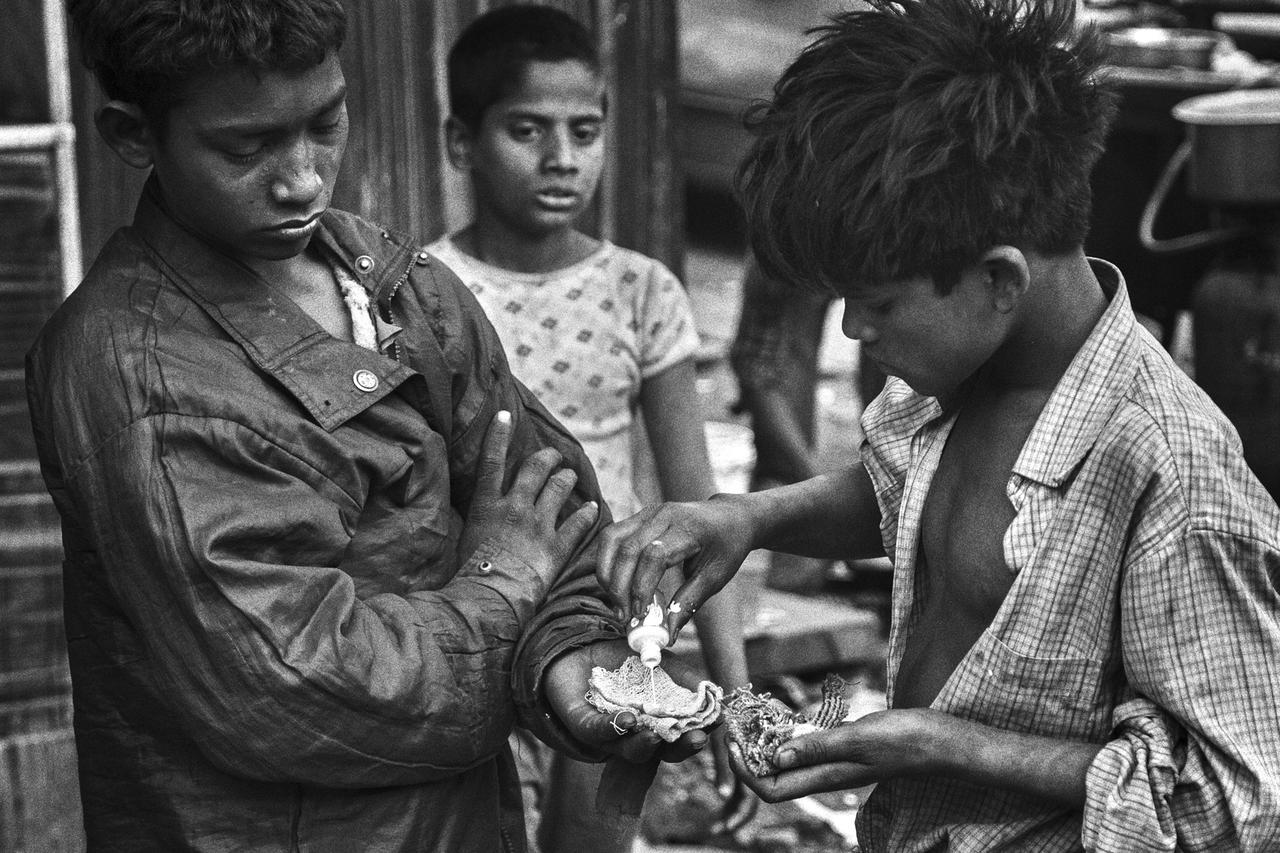
  • Drugs and alcohol abuse: a huge factor led to homelessness today and an increasingly significant issue. It can also be something that people that are homeless fall back on. 
Homelessness in India:

A film that can help deepen our understanding of this is Slumdog Millionaire, a film which is about streetchildren in India. We can perhaps incorporate clips from this film into our performance.

One in every 100 people in India's cities are homeless and increasingly so.  Here is some information from a charity website, Slumdogs about the causes and effects of being homeless:

Abuse:
Many of the street children who have run away from home have done so because they were beaten or sexually abused. Tragically, their homelessness can lead to further abuse through exploitative child labour and prostitution. Not only does abuse rob runaway children of their material security, but it also leaves them emotionally scarred. Many of the abused children are traumatised and some refuse to speak for months after being rehomed. To aggravate matters, children often feel guilty and blame themselves for their mistreatment. Such damage can take years to recover from in even the most loving of environments; on the streets it may never heal.

Child Labour:

Most Indian street children work. In Jaipur, a common job is rag-picking, in which boys and girls as young as 6 years old sift through garbage in order to collect recyclable material. The children usually rise before dawn and carry their heavy load in a large bag over their shoulder. Rag-pickers can be seen alongside pigs and dogs searching through trash heaps on their hands and knees. Other common jobs are the collecting of firewood, tending to animals, street vending, dyeing, begging, prostitution and domestic labour.
Children that work are not only subject to the strains and hazards of their labour, but are also denied the education or training that could enable them to escape the poverty trap.

Gender Discrimination:

In Indian Society females are often discriminated against. Their health, education, prosperity and freedom are all impacted. The problem is worse in conservative Rajasthan than almost anywhere else in India.
The ratio of female:male homeless children is 1:10. This is explained by the awareness among young girls that they are very vulnerable to exploitation: violence, sexual abuse or being sold into prostitution where many will die of AIDS or simply "disappear" out of sight.

Health:

Poor health is a chronic problem for street children. Half of all children in India are malnourished, but for street children the proportion is much higher. These children are not only underweight, but their growth has often been stunted; for example, it is very common to mistake a 12 year old for an 8 year old.
Street children live and work amidst trash, animals and open sewers. Not only are they exposed and susceptible to disease, they are also unlikely to be vaccinated or receive medical treatment. Only two in three Indian children have been vaccinated against TB, Diphtheria, Tetanus, Polio and Measles; only one in ten against Hepatitis B. Most street children have not been vaccinated at all. They usually can not afford, and do not trust, doctors or medicines. If they receive any treatment at all it will often be harmful, as with kids whose parents place scalding metal on their bellies as a remedy for persistent stomach pain.

Child labourers suffer from exhaustion, injury, exposure to dangerous chemicals, plus muscle and bone afflictions.

There is much ignorance about reproductive health and many girls suffer needlessly. A girl made infertile by an easily-preventable condition may become unmarryable and so doomed to a life of even greater insecurity and material hardship.
The HIV/AIDS rate amongst Indian adults is 0.7% and so has not yet reached the epidemic rates experienced in Southern Africa. However, this still represents 5 million people, or about 1 in 7 in of those in the world who have the disease. The rate amongst children is lower, but because street children are far more sexually active than their Indian peers and because many are even prostitutes they are thus hugely at risk of contracting the disease. AIDS awareness, testing and treatment exist, but less so for street children than other demographic groups.

Homelessness:

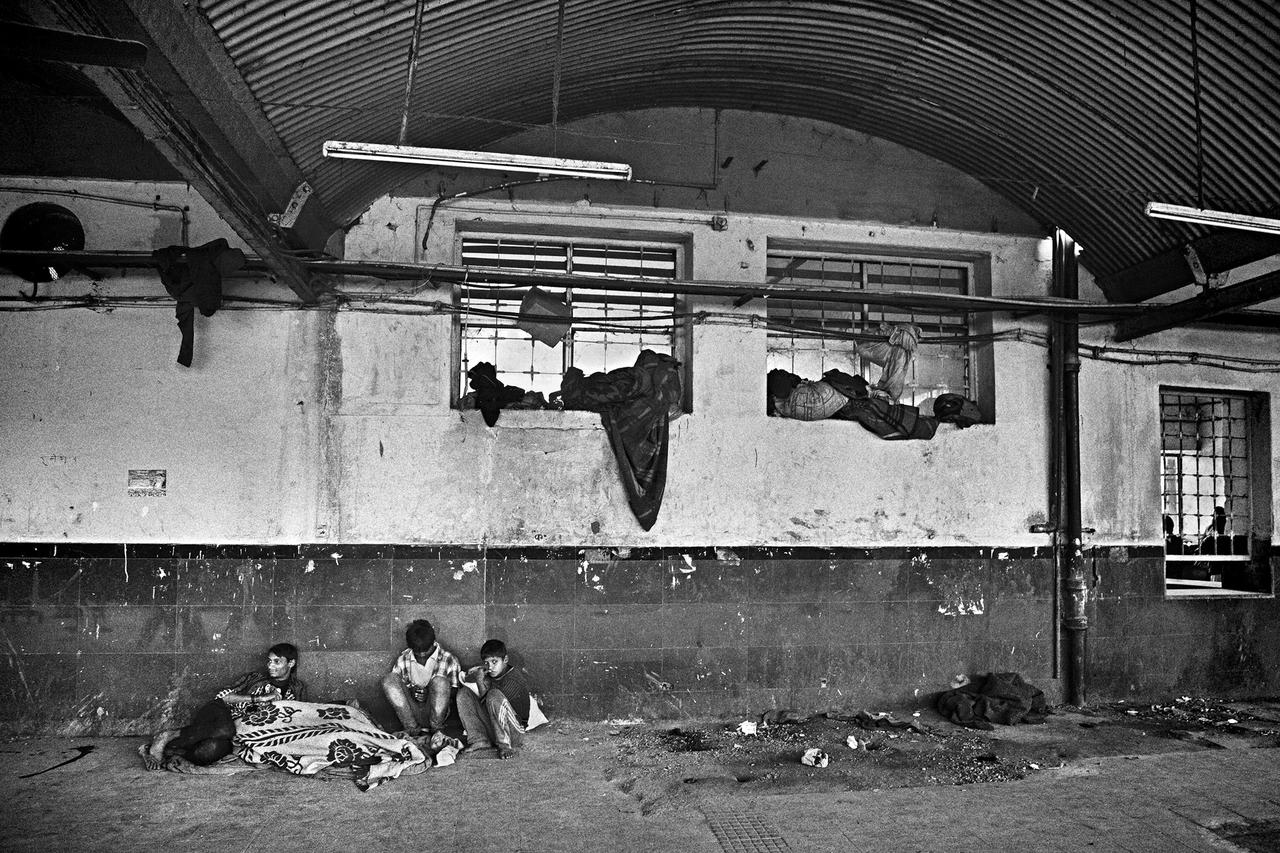
Street children in India may be homeless because their family is homeless through poverty or migration, or because they have been abandoned, orphaned or have run away. It is not unusual to see whole families living on the sidewalks of Jaipur, or rows of individual children sleeping around the railway station.
Homeless children have the odds stacked against them. They are exposed to the elements, have an uncertain supply of food, are likely miss out on education and medical treatment, and are at high risk of suffering addiction, abuse and illness. A single child alone on the streets is especially vulnerable.

Poverty:

Poverty is the prime cause of the street children crisis. Children from well-off families do not need to work, or beg. They live in houses, eat well, go to school, and are likely to be healthy and emotionally secure.
Poverty dumps a crowd of problems onto a child. Not only do these problems cause suffering, but they also conspire to keep the child poor throughout his/her life. In order to survive, a poor child in India will probably be forced to sacrifice education and training; without skills the child will, as an adult, remain at the bottom of the economic heap.