W6
Evaluation of the Devising Process + Performance
Rehearsal
In terms of Rehearsal, not everyone showed up every rehearsal we scheduled and this was very frustrating at times. However, the majority did and this helped us progress as a group and become more familiar with what we were doing, especially in the early weeks of the devising process. If I had to do this again, I'd say that the amount of rehearsals we had was sufficient because we were productive in class and out of class, so didn't need lots and lots more of rehearsals compared to the ones we did have. My only query is for those who didn't turn up to rehearsals because it meant that we wasted time recapping the new changes and adaptions to the piece to those people. Other challenges of rehearsals were the fact that our performance heavily relies on having an audience because the audience lead the action, it is built around them and where they are within the piece. Also, using props such as the washing line (which we didn't have sorted until a week before) were essential and without this prop and an audience, we were unaware of how much space we needed to leave for fifteen people. Finally, another challenge of rehearsal time was that because we were based in the Space, a very popular room for rehearsals within the school, when we weren't rehearsing there, we'd usually be rehearsing in a smaller space. In this smaller space, we'd have to compress the amount of props and space we were using to fit and then when rehearsing in the Space, we'd have to make it bigger again to utilise all of the room.
Set, Music, Lighting + Props
Set, Music, Lighting + Props
The set was one of the most effective parts of our piece and it was very convenient for us to use The Space, such a wide and equipped room. I really enjoyed setting it up with other people in my group and it ended up that everyone came together to incorporate their own ideas on what the set should look like. Also, many audience members complimented the set and its creativity.

This is the entrance door with Indian tourist destinations stuck on. This was my idea and I think it was effective because it gave the audience an idea of what country they were in and a thinking point before they entered the room. It could have easily become very unclear without little hints like this for the audience to understand where the piece was set and the location was absolutely vital for them to know.

The set from the entrance door. The audience don't see this entire space at first. From this picture, we can see that the room is a lot darker as the audience enter and a lot lighter as they reach the other end of the room. Plastic bags were used, kindly donated by post 16, to represent the litter and over population in India. This idea was very good because it filled the space and made the set stand out so much more but the only problem was that some of the plastic bags were hazards for audience members walking by. We fixed this by moving plastic bags and making slight pathways out of them.

The area the audience were trapped in via the washing line. The washing line was effective because we always knew where our audience were at all times and it helped them use their senses to build a more immersive experience.

The audience were released out of the tiny space and were moved to Aaron's stall. Behind Aaron's stall, they may have seen the drawings on the wall, handrawn by us and our younger family members. This is a multimedia element, portraying ideas through art.

Aaron's stall. It had the Indian flag on it, with oranges, water, apples, pears and spice. The Indian flag was again another hint to the audience and props from Aaron's stall were used in latter scenes in the piece.

The view of Aaron's set.

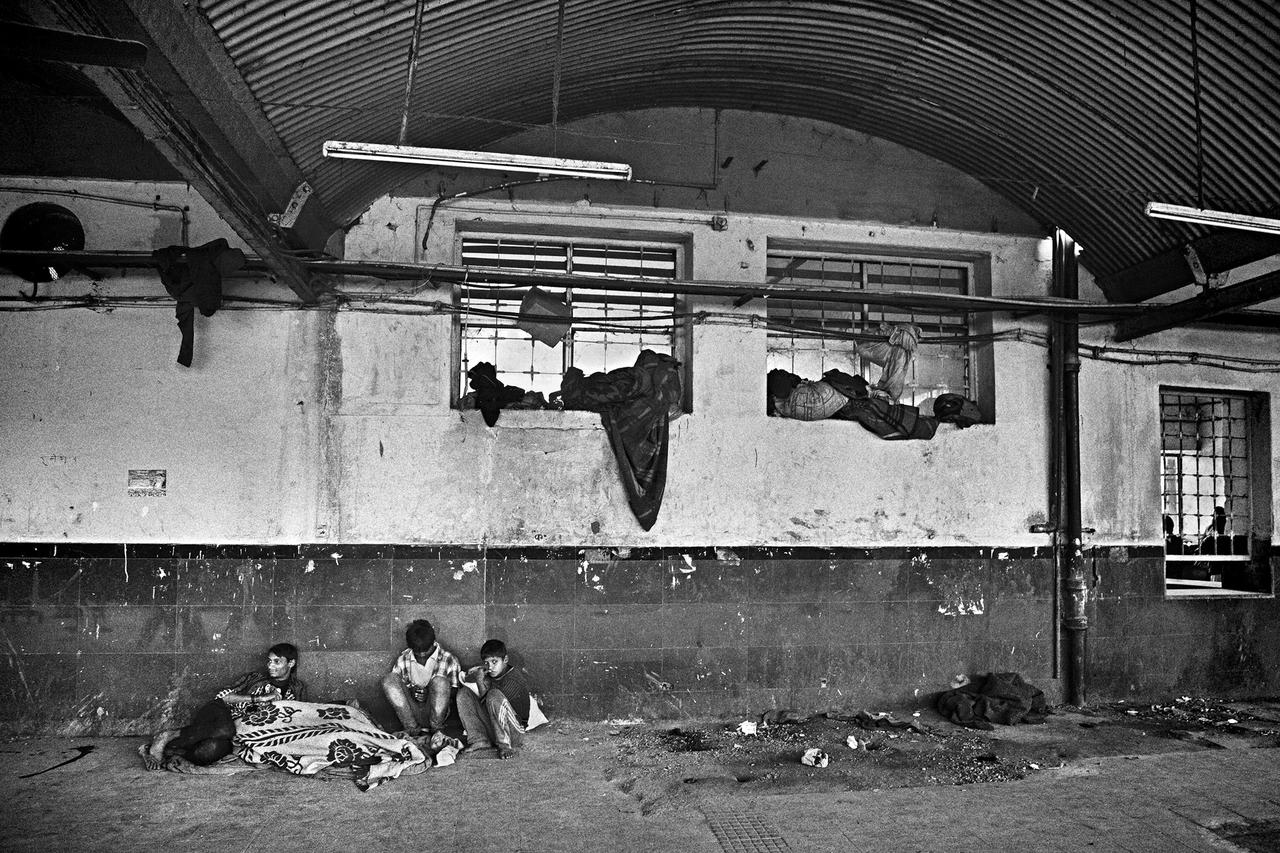
The next place the audience were taken to was the 'Homeless hut', where Zafra and Amelia were. We decorated the outside of the white block with newspaper. I think this idea was purely based on knowledge of finding out during research that many street children sleep in cramped, unhygienic places such as under railway bridges.


Inside the homeless hut were old sheets, newspapers and pictures of Western idols and Bollywood idols. There was also pictures of their family members that we have stuck there. Pictures of these people inside gave the characters in the hut more dimension because it shows they're human, rather than just being 'miserable homeless people'. The problem with the hut was that the audience had to squat to see the ongoing scene and those who didn't do this had difficulties seeing what was happening. This could have destructed their illusion and broken the immersive theatre as they struggled to see the action and may have gotten distracted.


The next part the audience are taken to is a studio in India. We made this by simply using one white block, Amelia sat on the stool and Esme took pictures of her, making her do uncomfortable poses. The camera was made by Mr Rennison out of Nesquick tubes and velcro, useful for our next scene.

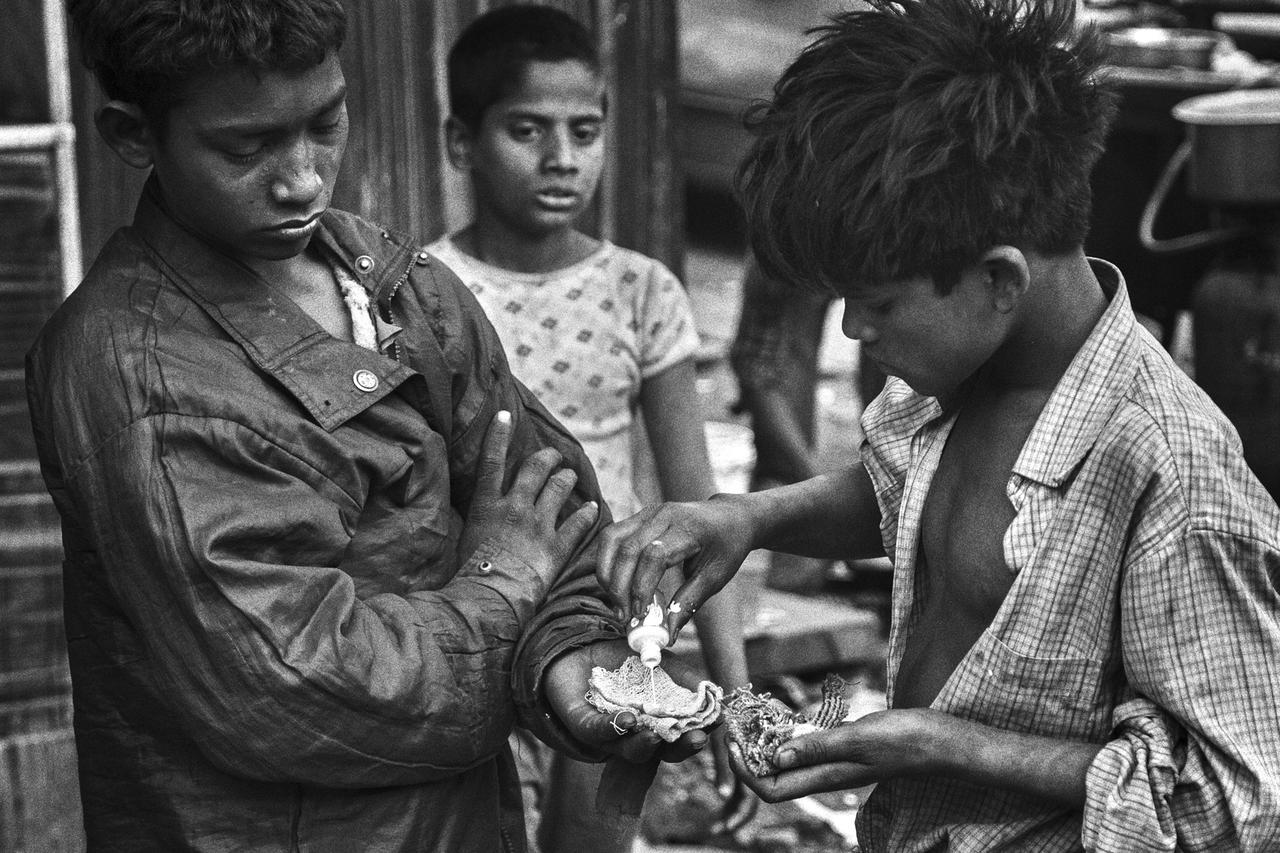
The next part was the Physical Theatre part of the piece, the final 'scene'. We used a shelf, which Ruby and Charlie did their gesture theatre on and myself and Poppy used rags/sheets underneath the action on the shelf, to create a scene about kids taking drugs. We used the camera from the previous scene which contained peanut butter, to act as the 'drugs'. This is one of my favourite elements of the piece we create because it shows in an abstract way that when the kids have the camera in their hands, then rip it apart and it becomes the drugs they sniff, the way in which many street children's motives are to steal valuable equipment like cameras (as Amelia did) and use it for drugs because so many young children are addicted in India.

Lighting
The lighting in this piece was good. It brought our set to life by conveying certain emotions through colours, for example 'dark blue' could convey misery, shame etc and showed the time scale of Day-Night from lighter areas of the room to other ones.
Props + Music used
Throughout the course of the piece, we used a strap over the shoulder bag that I brought in, that was colourful and tie-died (fitting in the theme of India/Indian fashion). I put this bag over my shoulder and used Amelia's iPad mini to play the music we used in this piece. (See Performance Material post). This was my idea and although this was a creative way of controlling the music and making the music always be around the audience, sometimes it was difficult to be involved in the action and move the washing line while controlling the music. Also, I don't know if the music we played was heard by every audience member. However, because we didn't have speakers and all of us were participating in things, this idea really worked and I think it was done in a way which didn't direct the audience's attention.
In terms of music, I was very passionate about having a continuous drum beat over certain pieces of the piece created by us as actors, such as the gesture theatre piece at the end. However, the idea and mood of it was a soft, relaxing atmosphere and the idea of a drum beat was a bit too harsh.
In general, the props were absolutely essential otherwise this immersive piece would not have worked out. They help provide realism for the audience and take them into another world by blocking out their reality, they help engage the audience and they help contain the audience (e.g washing line)
The Performance
One of the challenges of this performance was the timing. A number of times, when we'd just let one audience out, we'd notice that another audience would already be stood there ready. This may have broken the immersive theatre experience for them and setting up quickly enough to be there ready to let a new audience in was a challenge, however I think we overcame this well. We remained calm and just returned to our positions in neutral stance ready, with all the props we needed. Times when the audience were left waiting outside never exceeded around 2-3 minutes.
The Performance
One of the challenges of this performance was the timing. A number of times, when we'd just let one audience out, we'd notice that another audience would already be stood there ready. This may have broken the immersive theatre experience for them and setting up quickly enough to be there ready to let a new audience in was a challenge, however I think we overcame this well. We remained calm and just returned to our positions in neutral stance ready, with all the props we needed. Times when the audience were left waiting outside never exceeded around 2-3 minutes.
Another challenge was the fact that sometimes audience members surprised you. There'd be young audience members or the audience would make something very serious rather comical, which wasn't the mood we were trying to portray. Although different audience members will interpret things differently, sometimes the mood was lost generally in moments like this. We had to improvise around this because the audience entirely lead the piece, not us or else it wouldn't be very naturalistic.
Something that I believe really worked within our piece was Aaron's interaction at the stall. I think it's because it really made audience members get involved. Aaron played his character so convincingly and really committed, forcing audience members to say something and feel more included in the action. It also showed very clearly con artistry in India, which is something very interesting that some of the audience members may have never learnt before.
At the end of our performance, all groups/'camps' joined up together to sing a song. It incorporated the theme of the entire piece: the older generation have left the world in the state that it is in, with unethical things happening all over the World and what can they do to help? As well as this, we ended the performance on some personal audience interaction: we would take an audience member and improvise by questioning them. 'What did you want for the world when you were younger?' 'What do you want for your children?' etc and ending on 'You can have what you want. You are powerful'. Because it was an intimidate questioning, it really helped us connect to the audience. It was the last thing they were given during the performance and it holds so much meaning and inspiration so it leads a lasting mark on the audience and makes an impact, the aim of our piece.
Other groups had some really effective ideas that contributed to the successful play too. I particularly liked the idea of Guantanamo Bay's group, having Barack Obama's speech play. It incorporates multimedia aspects and shows how some things are portrayed in the media compared to what they actually are.
Things I've learnt during this unit
This is the first time I'd ever done immersive theatre and especially after this unit, I believe it is very important. This is because you can make the audience whoever you want and make them believe and think and open their mind to different situations that some of them would never consider on a daily basis until they were being forced by to do a stress position by Brit School students. A lot of the audience members went away with something to think about, no matter what it was that they took from the play and this is an important element to theatre.
Secondly, I learnt just how research is absolutely essential to everything in theatre, especially devising. You want to use real stories to make your characters real and non stereotypical and to give your audience a truly realistic impression. I definitely developed the skill of shaping research into presented theatrical ideas in the piece. For example, the statistics of runaway adolescents from their parents was represented through our gesture theatre piece at the end with a girl and her dad. (Ruby and Charlie) This links to last terms unit, about knowing your character.
I also developed the skill of devising in teams. With a lot of passion brings a lot of voices and you have to be open to other people's ideas, as well as being able to have ideas rejected or ideas adapted for the sake of the performance.
Finally, I learnt during this devising unit that the audience lead everything. The skill of having to adapt and improvise dependent on the audience is very important to have because if you don't, it'll break the illusion for them completely.
Things I've learnt during this unit
This is the first time I'd ever done immersive theatre and especially after this unit, I believe it is very important. This is because you can make the audience whoever you want and make them believe and think and open their mind to different situations that some of them would never consider on a daily basis until they were being forced by to do a stress position by Brit School students. A lot of the audience members went away with something to think about, no matter what it was that they took from the play and this is an important element to theatre.
Secondly, I learnt just how research is absolutely essential to everything in theatre, especially devising. You want to use real stories to make your characters real and non stereotypical and to give your audience a truly realistic impression. I definitely developed the skill of shaping research into presented theatrical ideas in the piece. For example, the statistics of runaway adolescents from their parents was represented through our gesture theatre piece at the end with a girl and her dad. (Ruby and Charlie) This links to last terms unit, about knowing your character.
I also developed the skill of devising in teams. With a lot of passion brings a lot of voices and you have to be open to other people's ideas, as well as being able to have ideas rejected or ideas adapted for the sake of the performance.
Finally, I learnt during this devising unit that the audience lead everything. The skill of having to adapt and improvise dependent on the audience is very important to have because if you don't, it'll break the illusion for them completely.